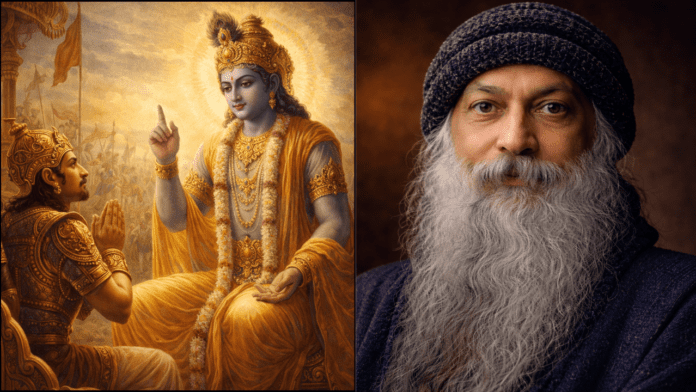
Osho and the Gita: Does Osho’s teachings contradict the essence of the Bhagavad Gita? Or do they remain mostly the same?
Osho is loved by many spiritual communities, whether they are Hindu or not, and despite him having the left his earthly body over 3 decades ago, his popularity just keeps on rising. At the same time, there are also many conservative and traditional Hindus who feel that he defied the core tenets of Sanatan Dharma. His sharp criticism of rituals, morality, organized religion, and social conditioning often makes him appear against some core principles of Sanatan Dharm or even anti-spiritual to ignorant audiences. This discomfort deepens when Osho is compared with the Bhagavad Gita, one of the most sacred pillars of Hindu philosophy.
However, what is often ignored is who these teachings were addressed to. Sri Krishna was speaking to Arjuna, a trained, disciplined warrior raised within a strict dharmic framework. Osho, by contrast, was speaking primarily to an urban, modernized, psychologically fragmented audience shaped by repression, hypocrisy, and identity confusion. Judging one through the lens of the other without accounting for this difference creates a false conflict. To understand whether Osho truly contradicted the Gita, one must move beyond tradition-versus-rebellion narratives and examine their teachings at the level of essence.
Context Shapes Language, Not Truth
The Bhagavad Gita emerges from a civilization where order already existed. Social roles were defined, discipline was assumed, and duty was embedded into daily life. Arjuna’s crisis was not a rejection of society but a collapse under emotional attachment. Krishna’s task was to restore clarity without dismantling structure.
Osho faced the opposite problem. Modern society had structure without consciousness. Morality without awareness. Freedom without responsibility. He spoke to a society where repression and hypocrisy was quite common. His audience was not trained and disciplined warriors but inwardly confused individuals trying to look for virtue in life while living unconsciously. His language therefore had to be disruptive.
The Gita refines order.
Osho dismantles false order.
Self, Ego, and the Question of Identity
The Gita’s central teaching is that the individual is not the body or the mind, but the Atman. Ego, or ahamkara, is false identification with action and outcome. Liberation comes through seeing this clearly.
Osho delivers the same insight stripped of metaphysics and tradition. He speaks of awareness instead of Atman, conditioning instead of samskara, and ego as a psychological structure created by society. Yet the pointer remains the same. Suffering arises from mistaken identity.
Different vocabulary. Same realization.
Action, Duty, and Inner Freedom
Krishna does not ask Arjuna to renounce action. He asks him to renounce attachment. Action rooted in clarity is dharma. Action rooted in fear or desire is bondage.
Osho echoes this but removes the language of duty because many of his audience already uses duty as an excuse to avoid self-awareness. He attacks mechanical morality, not responsibility. For him, right action arises naturally from consciousness, not obligation.
Traditionalists often misread this as irresponsibility. In reality, it is actually responsibility without ego or fear.
Desire, Renunciation, and Moral Panic
One of the biggest accusations against Osho is that he promoted indulgence. This comes from selective listening. Osho rejected repression and indulgence equally. Both, in his view, arise from unconsciousness.
The Gita makes the same claim more subtly. Desire binds when rooted in ego. Suppression binds when rooted in fear. True renunciation is inner, not performative.
Both teachings aim at transcendence, not control.
Authority, Tradition, and Shock
The Gita works within tradition. Its subversion is internal. It does not challenge institutions too much because at the time the people were already conscious to a certain extent.
Osho openly attacked authority because his audience worshipped symbols while remaining unconscious. Shock was his method, not his philosophy. He shattered false certainty so awareness could emerge.
This is where many conservative Hindus feel betrayed. Yet the threat is not to dharma itself, but to social comfort mistaken for spirituality.
Misuse by Followers
The Gita has often been quoted by people in positions of authority to justify power and violence. Osho is quoted by lifestyle liberals to excuse indulgence, laziness, and a refusal to take responsibility, while conveniently ignoring his relentless insistence on meditation, awareness, discipline, and self-honesty.
Depth always gets distorted by shallow minds.
Comparing Osho and the Gita: Where They Truly Converge
At the level of essence, the convergence is clear.
The Gita says freedom comes through self-knowledge and non-attachment.
Osho says freedom comes through awareness and deconditioning.
One speaks to a disciplined warrior.
The other speaks to a confused modern individual.
But both dissolve ego. Both reject unconscious living. Both aim at liberation, not belief.
Conclusion
It is also worth remembering that while he was alive, Sri Krishna himself was not universally accepted as a spiritual authority.To many orthodox and conservative groups of his time, he appeared as a disruptive figure who questioned rigid ritualism, challenged inherited hierarchies, and encouraged direct inner realization over blind adherence to tradition. In that historical moment, such questioning was often seen not as renewal, but as rebellion against Sanatan Dharma.
Similarly, today, the conflict between Osho and the Bhagavad Gita is largely a misunderstanding born of context. Conservative and traditional Hindus often judge Osho through the lens of social preservation, while many admirers sometimes strip his teachings of discipline and depth. Both miss the point.
At the level of essence, there is no contradiction.
Only a difference in audience, language, and method.
Krishna spoke to a world that needed more understanding.
Osho spoke to a world that needed dismantling.
If you disagree with Osho on certain subjects, it is completely fine and understandable. No one is perfect. But if you dislike him thinking that he contradicted the core principles of Sanatan Dharm, then you have been hugely misguided.
