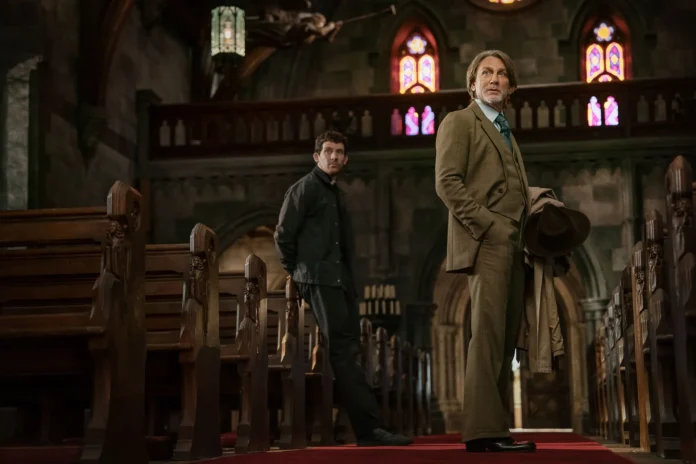
Wake Up Dead Man takes the Knives Out series in a darker direction, delivering a slow burn mystery with strong payoff and thoughtful themes.
Directed by Rian Johnson, Wake Up Dead Man: A Knives Out Mystery is the third standalone entry in the Knives Out franchise and was released on Netflix on 12th Dec 2025. The film brings back Daniel Craig as Benoit Blanc and features an ensemble cast that includes Josh O’Connor, Cailee Spaeny, Glenn Close, Josh Brolin, Andrew Scott, and Mila Kunis. From its opening moments, the film signals a decisive shift in tone, moving away from flamboyant satire toward a quieter, darker, and more introspective form of storytelling.
Rather than attempting to outdo its predecessors in spectacle or wit, Wake Up Dead Man narrows its focus. So we have a film that prioritizes atmosphere, moral tension, and narrative payoff over constant momentum.
Story and Screenplay
The strongest element of Wake Up Dead Man is its story. The mystery is carefully constructed and remains unpredictable throughout, resisting the temptation to rely on obvious red herrings or surface level twists. You will stay hooked to the screenplay which gradually reveals a web of events that stretches back several decades, allowing the present day crime to be recontextualized through the weight of history.
What makes the mystery especially effective is the sense of completeness in its resolution. By the time the mysteries are revealed, every major narrative thread finds purpose by the end, and the final reveal does not feel engineered for shock alone. Instead, Wake Up Dead Man properly delivers a sense of narrative closure that is increasingly rare in modern whodunnits. The payoff is indeed not just clever but also emotional, grounding the solution in character motivation rather than clever mechanics.
Many critics have highlighted the film’s willingness to slow down and let its story unfold organically. That patience allows the screenplay to explore long buried guilt, moral compromise, and the consequences of past choices. As a result, the mystery feels less like a puzzle to be solved and more like a reckoning that has been postponed for decades.
As a murder mystery thriller, the film definitely satisfies what you expect from it! It won’t be wrong to say that it stands comfortably alongside, and arguably above, the first Knives Out film.
Direction and Tone
Rian Johnson’s direction in Wake Up Dead Man represents a clear tonal departure from Glass Onion. Where the second film embraced excess, satire, and noise, this third entry chooses restraint. The pacing is deliberate, the visual language subdued, and the humor largely understated.
Many might find it surprising that unlike the first and second movie, this one is a story around a religious community, but this shapes the film’s atmosphere in a meaningful way. Themes of faith, guilt, forgiveness, and institutional silence are woven into the fabric of the story rather than layered on top of it. The setting is not ornamental nor does it feel forced.
While most will love the film’s maturity and confidence, and might also find it the most ambitious entry in the franchise, others can find the pacing occasionally quite slow, particularly those viewers expecting a faster moving mystery.
The film often feels closer to a character driven drama than a traditional whodunnit. However, this is clearly a deliberate choice rather than a lapse in control. The film prioritizes thematic cohesion over immediacy, and it trusts the story to eventually justify its patience. And yes, by the end, you will remain shocked because you will surely have never predicted its ending, and you might have never doubted the killer too.
Performances and Character Focus
One of the most striking choices in Wake Up Dead Man is its use of Benoit Blanc. Daniel Craig’s performance is notably restrained, and the character does not dominate the film in the way he might have done previously. Blanc is absent for a significant portion of the opening act, allowing the story to establish its emotional core before introducing the world-renowned detective.
Wake Up Dead Man places greater emphasis on the rest of the cast, particularly Josh O’Connor’s portrayal of assistant padre Jud, who emerges as the film’s emotional anchor. His performance has been widely recognized as the standout, grounding the film’s moral questions with sincerity and quiet intensity. Rather than functioning as a mere supporting character, he becomes the lens through which much of the film’s ethical tension is explored.
Craig’s subdued approach complements the film’s structure. Blanc is observant, patient, and purposeful, intervening only when necessary. His presence feels measured rather than performative, reinforcing the sense that this story belongs to a community rather than a single investigator.
The rest of the cast delivers consistently strong performances, avoiding caricature and excess. Characters feel like individuals shaped by history, belief, greed and compromise rather than exaggerated symbols.
Themes and Social Commentary
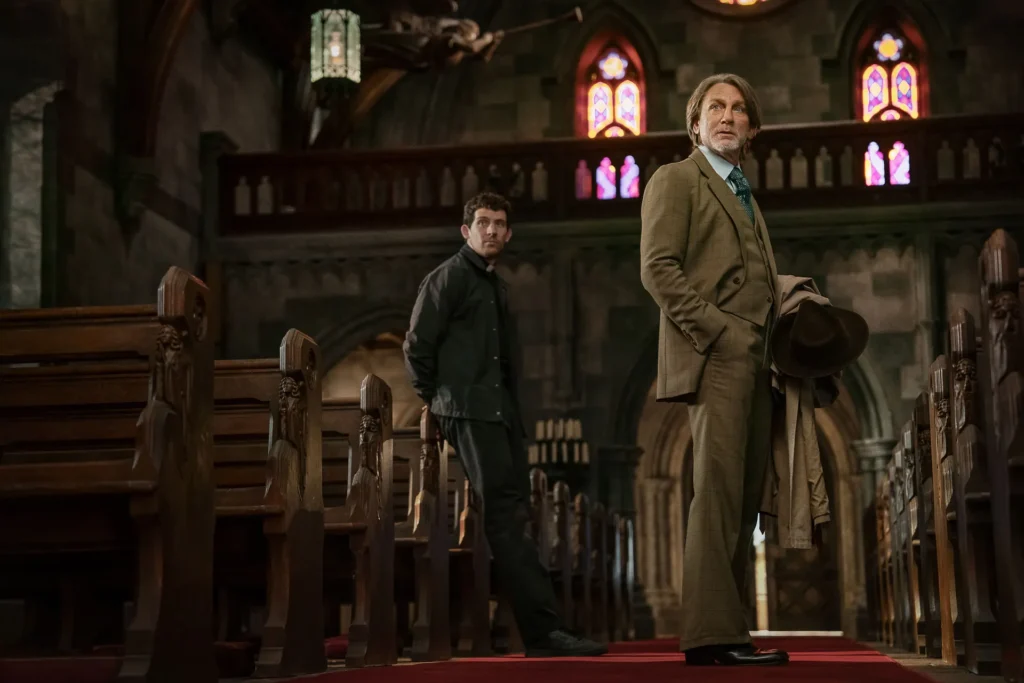
Social commentary has always been part of the Knives Out series, but Wake Up Dead Man approaches it with far more maturity than the previous film. The movie deals with ideas like power, hypocrisy, and responsibility, but it does so quietly. These themes sit beneath the story. So don’t worry, it won’t push anything to your face, as the film allows the mystery to remain the main focus.
Instead of relying on loud satire or exaggerated characters, the film lets its themes take shape through the events and the people involved. Nothing feels forced or performative. The commentary grows naturally as the story unfolds, which makes it feel honest rather than agenda driven.
This restraint ends up working in the film’s favor. The social themes add weight to the mystery instead of distracting from it, and this gives the story more depth without overwhelming it. That sense of balance brings the series back to a more disciplined and serious tone, one that feels confident and grounded.
Pacing and Structural Weaknesses
The film’s pacing is probably its only weakness. The slow burn structure requires patience, and there are stretches where forward momentum slows considerably. For some viewers, this can feel either annoying or overly meditative.
However, you could argue that the pacing also enables the film’s greatest strengths. It allows atmosphere to settle, character relationships to develop, and long term threads of the story to carry weight. The sense of unease and moral tension builds gradually, thus the resolution that feels earned rather than rushed.
Final Verdict
Wake Up Dead Man: A Knives Out Mystery is definitley a confident and mature entry in the franchise. If you are looking for a mystery movie that prioritizes excess in favor of restraint, delivering a mystery that values atmosphere, character, and moral complexity over pure spectacle, you can definitely watch it!
